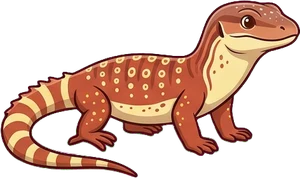
Ackie Monitor care guide
Varanus acanthurus · Care info checked against current care sheets in October 2026
Quick facts
| Scientific name | Varanus acanthurus |
|---|---|
| Also called | Spiny-tailed monitor, ridge-tailed monitor |
| Care level | Intermediate |
| Active | Diurnal |
| Lives | Terrestrial / burrowing |
| Adult size | 60 to 70 cm (24 to 28 in) |
| Lifespan | 15 to 20 years |
| Minimum enclosure (one adult) | 150 x 75 x 120 cm (59 x 30 x 47 inches) |
| Basking spot | 60 to 78°C (140 to 172°F) |
| Warm side | 32 to 38°C (90 to 100°F) |
| Cool side | 24 to 29°C (75 to 84°F) |
| Night | 21 to 24°C (70 to 75°F) |
| Humidity | 20 to 60% |
| UVB lighting | Required (Ferguson zone 3) |
| Diet | Insectivore |
| Feeding, babies | every day |
| Feeding, juveniles | every 1 to 2 days |
| Feeding, adults | every 2 to 3 days |
Overview
A small, very active monitor from Australia that spends its day basking, digging and hunting. Ackies reward a large, deep-substrate enclosure with bold, visible behavior, but they need very high basking temperatures and strong UVB to thrive.
Enclosure
Provide at least 150 x 75 x 120 cm (59 x 30 x 47 inches) for one adult, and more if you can. The extra height holds the deep substrate. Substrate should be deep enough to dig stable burrows, ideally 30 cm (11.8 in) or more of a sand and soil mix that holds its shape when damp. Stack flat rocks under the basking spot so the animal can choose its distance from the heat.
Heat, humidity and lighting
Aim for a basking surface of 60 to 78°C (140 to 172°F) under clustered halogen floods, with the air falling off to about 24 to 29°C (75 to 84°F) (75 to 84°F) on the cool end. Deep burrows stay cooler and more humid than the air above, so many ackies spend their downtime underground, often right under the basking spot. Use a strong linear UVB (Ferguson zone 3 to 4) covering most of the enclosure, and replace it on the manufacturer's schedule. Keep the air fairly dry (about 20 to 60%) but the lower substrate damp, so burrows stay humid.
Diet
Feed babies daily, juveniles every day or two, and adults every 2 to 3 days with a variety of gut-loaded insects. Small, frequent meals suit ackies better than large, rare ones. Dust with calcium most feedings plus a multivitamin about weekly.
Health
Weigh regularly and watch for weight loss, lethargy, retained shed on the toes and tail tip, and swelling in the jaw or limbs, which can signal metabolic bone disease. A drop of more than 10% without a known reason is worth a vet visit.
Handling
Most ackies tolerate handling once settled, but they are fast and curious. Keep sessions short at first, support the body fully, and let the animal return to its basking spot afterward to warm back up.
See a vet if you notice
Weight loss, lethargy, stuck shed on toes or tail tip, swollen jaw or limbs.
Other languages: ČeštinaDeutschEspañolFrançaisBahasa IndonesiaItaliano日本語한국어NederlandsPolskiPortuguês (Brasil)SvenskaTürkçe简体中文