Blood Python care guide
Python brongersmai · Care info checked against current care sheets in November 2026
Quick facts
| Scientific name | Python brongersmai |
|---|---|
| Also called | Red blood python, Malaysian blood python, short-tailed python |
| Care level | Intermediate |
| Active | Nocturnal |
| Lives | Terrestrial |
| Adult size | 120 to 180 cm (47 to 71 in) |
| Lifespan | 20 to 25 years |
| Minimum enclosure (one adult) | 150 x 75 x 60 cm (59 x 30 x 24 inches) |
| Basking spot | 31 to 33°C (88 to 91°F) |
| Warm side | 29 to 31°C (84 to 88°F) |
| Cool side | 26 to 28°C (79 to 82°F) |
| Night | 24 to 27°C (75 to 81°F) |
| Humidity | 60 to 70% |
| UVB lighting | Optional (Ferguson zone 2) |
| Diet | Whole prey |
| Feeding, babies | every 7 to 10 days |
| Feeding, juveniles | every 10 to 14 days |
| Feeding, adults | every 14 to 28 days |
Overview
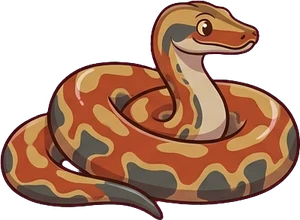
A short, very thick python from the swamp forests of Malaysia, Sumatra and Thailand, in shades of red, orange and tan. Adults are usually 1.2 to 1.8 meters but heavy for their length. Young ones can be feisty, but most settle down. They live 20 to 25 years.
Enclosure
An adult needs at least 150 x 75 x 60 cm (59 x 30 x 24 inches). Give a hide on each side, a water bowl big enough to soak in, and a deep, damp substrate like topsoil and coconut fiber with leaf litter. They like to burrow and don't climb much.
Heat, humidity and lighting
Blood pythons like it warm but not hot. Give a basking spot of 31 to 33°C (88 to 91°F), a warm side of 29 to 31°C (84 to 88°F) and a cool end of 26 to 28°C (79 to 82°F), with nights at 24 to 27°C (75 to 81°F). Keep humidity at 60 to 70%. Low UVB is optional.
Diet
Feed frozen-thawed rats. Hatchlings eat every 7 to 10 days, growing snakes every 10 to 14 days, and adults every 2 to 4 weeks. Blood pythons get fat easily, so feed smaller meals for their size and watch their shape.
Health
Watch for obesity, wheezing or nose bubbles, stuck shed, mites and belly scale problems from wet substrate.
Handling
Young blood pythons can be defensive. Use a hook to lift the head end and support the heavy body with both hands. Short, calm, regular sessions usually tame them.
See a vet if you notice
Obesity, wheezing or nose bubbles, stuck shed, scale rot from soaking-wet substrate, mites.
Other languages: ČeštinaDeutschEspañolFrançaisBahasa IndonesiaItaliano日本語한국어NederlandsPolskiPortuguês (Brasil)SvenskaTürkçe简体中文