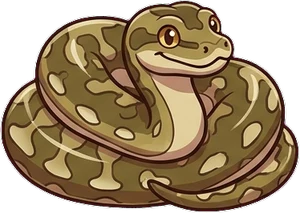
Carpet Python care guide
Morelia spilota · Care info checked against current care sheets in November 2026
Quick facts
| Scientific name | Morelia spilota |
|---|---|
| Also called | Coastal carpet python, jungle carpet python, diamond python |
| Care level | Intermediate |
| Active | Crepuscular |
| Lives | Semi-arboreal |
| Adult size | 150 to 250 cm (59 to 98 in) |
| Lifespan | 20 to 30 years |
| Minimum enclosure (one adult) | 200 x 90 x 90 cm (79 x 35 x 35 inches) |
| Basking spot | 35 to 38°C (95 to 100°F) |
| Warm side | 28 to 32°C (82 to 90°F) |
| Cool side | 24 to 27°C (75 to 81°F) |
| Night | 21 to 25°C (70 to 77°F) |
| Humidity | 40 to 60% |
| UVB lighting | Recommended (Ferguson zone 2) |
| Diet | Whole prey |
| Feeding, babies | every 7 to 10 days |
| Feeding, juveniles | every 10 to 14 days |
| Feeding, adults | every 14 to 28 days |
Overview
A slender, climbing python from Australia and New Guinea, famous for its busy carpet-like pattern. Carpet pythons are active and alert, and young ones can be nippy, but most settle down into confident, curious adults. They live 20 to 30 years or more.
Enclosure
An adult needs at least 200 x 90 x 90 cm (79 x 35 x 35 inches), and taller is better because they love to climb. Give sturdy branches, shelves and a hide on each side. Use a deep, slightly damp mix like topsoil and coconut fiber that holds 40 to 60% humidity.
Heat, humidity and lighting
Give a basking surface of 35 to 38°C (95 to 100°F) under a heat lamp, a warm side of 28 to 32°C (82 to 90°F) and a cool end of 24 to 27°C (75 to 81°F), with nights at 21 to 25°C (70 to 77°F). In winter you can drop everything by 3 to 5°C (37 to 41°F). Keep humidity at 40 to 60%. UVB is recommended: a 5 to 6% T5 tube over the basking branch.
Diet
Feed frozen-thawed rodents or chicks. Juveniles eat every 7 to 14 days and adults every 2 to 4 weeks. Each meal should be about 10% of the snake's weight and no wider than 1.5 times its body.
Health
Watch for wheezing or bubbles at the nose, stuck shed, mites and weight loss. Jaguar morphs can have a nerve problem that makes the head wobble, so be careful when buying them.
Handling
Hatchlings can be quick to strike, but short, calm, regular handling usually tames them. Support the body and let them climb through your hands. Use a hook to start a session with a defensive snake, and wash your hands after.
See a vet if you notice
Wheezing or bubbles at the nose, stuck shed, mites, a stargazing or wobbling head (some jaguar morphs), losing weight.
Other languages: ČeštinaDeutschEspañolFrançaisBahasa IndonesiaItaliano日本語한국어NederlandsPolskiPortuguês (Brasil)SvenskaTürkçe简体中文