Gila Monster care guide
Heloderma suspectum · Care info checked against current care sheets in November 2026
Quick facts
| Scientific name | Heloderma suspectum |
|---|---|
| Also called | Gila, reticulate Gila monster, banded Gila monster |
| Care level | Advanced |
| Active | Crepuscular |
| Lives | Terrestrial / burrowing |
| Adult size | 35 to 55 cm (14 to 22 in) |
| Lifespan | 20 to 30 years |
| Minimum enclosure (one adult) | 120 x 60 x 45 cm (47 x 24 x 18 inches) |
| Basking spot | 32 to 35°C (90 to 95°F) |
| Warm side | 29 to 32°C (84 to 90°F) |
| Cool side | 24 to 27°C (75 to 81°F) |
| Night | 20 to 24°C (68 to 75°F) |
| Humidity | 30 to 50% |
| UVB lighting | Recommended (Ferguson zone 2) |
| Diet | Carnivore |
| Feeding, babies | every 7 to 10 days |
| Feeding, juveniles | every 10 to 14 days |
| Feeding, adults | every 14 to 21 days |
Overview
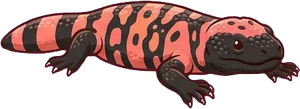
A slow, beaded lizard from the deserts of the southwestern US and northern Mexico, in pink, orange and black. Adults are usually 35 to 55 cm (21.7 in). It's one of the few venomous lizards: it bites, holds on and chews venom in, which is extremely painful. It's protected in the wild, so only keep captive-bred animals with any permits your area requires. They live 20 to 30 years.
Enclosure
An adult needs at least 120 x 60 x 45 cm (47 x 24 x 18 inches), with a locking lid. Give a deep sand and soil mix it can dig in, a hide on each side (one kept a little damp), flat rocks to bask on and a water bowl big enough to soak in. Label the enclosure as venomous.
Heat, humidity and lighting
Give a basking spot of 32 to 35°C (90 to 95°F), a warm side of 29 to 32°C (84 to 90°F) and a cool end of 24 to 27°C (75 to 81°F), with nights at 20 to 24°C (68 to 75°F). Keep humidity at 30 to 50%, with a damp hide. UVB is recommended: a T5 HO 6% tube over the basking area.
Diet
Feed frozen-thawed mice, chicks and the occasional egg. Babies eat about weekly, growing Gilas every 10 to 14 days, and adults every 2 to 3 weeks. They get fat easily, so watch the tail: plump is good, round and bulging is too much.
Health
Watch for obesity, a thin tail, mouth infections, stuck shed on toes and dehydration. Find a vet who treats venomous lizards before you need one.
Handling
Gilas are slow but have a strong grip and a very painful bite. Move them with snake tongs padded with tape, a hook under the body, or by guiding them into a tub, and never handle one by hand. If one bites and holds, keep calm, pry the jaw open with a flat tool and get medical help.
See a vet if you notice
Obesity, a thin tail, mouth infections, stuck shed on toes, kidney problems from dehydration.
Other languages: ČeštinaDeutschEspañolFrançaisBahasa IndonesiaItaliano日本語한국어NederlandsPolskiPortuguês (Brasil)SvenskaTürkçe简体中文