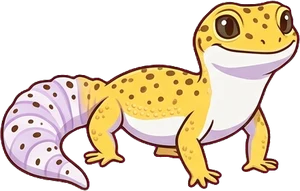
Leopard Gecko care guide
Eublepharis macularius · Care info checked against current care sheets in October 2026
Quick facts
| Scientific name | Eublepharis macularius |
|---|---|
| Also called | Leo, common leopard gecko |
| Care level | Beginner |
| Active | Crepuscular |
| Lives | Terrestrial |
| Adult size | 18 to 25 cm (7 to 10 in) |
| Lifespan | 15 to 20 years |
| Minimum enclosure (one adult) | 90 x 45 x 45 cm (35 x 18 x 18 inches) |
| Basking spot | 32 to 35°C (90 to 95°F) |
| Warm side | 27 to 30°C (81 to 86°F) |
| Cool side | 22 to 25°C (72 to 77°F) |
| Night | 18 to 22°C (64 to 72°F) |
| Humidity | 30 to 40% |
| UVB lighting | Recommended (Ferguson zone 1) |
| Diet | Insectivore |
| Feeding, babies | every day |
| Feeding, juveniles | every 2 to 3 days |
| Feeding, adults | every 3 to 5 days |
Overview
A small, gentle gecko from the rocky scrublands of South Asia and one of the easiest lizards to keep. Leopard geckos store fat in their tail, which makes tail thickness a handy health gauge.
Enclosure
Give at least 90 x 45 x 45 cm (35 x 18 x 18 inches) with a warm hide, a cool hide and a humid hide filled with damp moss for shedding. A solid, diggable substrate or a naturalistic mix works well.
Heat, humidity and lighting
Use an overhead heat source to warm a basking surface to about 32 to 35°C (90 to 95°F), with a cool side of about 22 to 25°C (72 to 77°F). Keep humidity fairly low overall but always offer the humid hide. Low UVB (Ferguson zone 1) is beneficial.
Diet
Feed babies daily, juveniles every 2 to 3 days, and adults every 3 to 5 days once the tail is plump, offering about 2 insects per inch of body length. Dust with calcium most feedings and a multivitamin weekly.
Health
A thinning tail, stuck shed on the toes, and wobbly walking are the big warning signs. Weigh monthly and check the toes after every shed.
Handling
Leopard geckos are usually calm once settled. Scoop from below rather than grabbing from above, and never hold them by the tail, which can drop.
See a vet if you notice
Stuck shed on toes, thinning tail, wobbly walking, lethargy.
Other languages: ČeštinaDeutschEspañolFrançaisBahasa IndonesiaItaliano日本語한국어NederlandsPolskiPortuguês (Brasil)SvenskaTürkçe简体中文