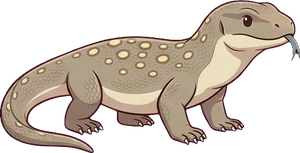
Savannah Monitor care guide
Varanus exanthematicus · Care info checked against current care sheets in November 2026
Quick facts
| Scientific name | Varanus exanthematicus |
|---|---|
| Also called | Bosc monitor |
| Care level | Advanced |
| Active | Diurnal |
| Lives | Terrestrial / burrowing |
| Adult size | 75 to 120 cm (30 to 47 in) |
| Lifespan | 10 to 15 years |
| Minimum enclosure (one adult) | 240 x 120 x 120 cm (94 x 47 x 47 inches) |
| Basking spot | 55 to 66°C (131 to 151°F) |
| Warm side | 30 to 38°C (86 to 100°F) |
| Cool side | 24 to 29°C (75 to 84°F) |
| Night | 21 to 27°C (70 to 81°F) |
| Humidity | 40 to 70% |
| UVB lighting | Required (Ferguson zone 3) |
| Diet | Insectivore |
| Feeding, juveniles | every day |
| Feeding, adults | every 1 to 3 days |
Overview
A stocky, powerful monitor from the grasslands of Africa. Savannah monitors are sold cheaply and often kept badly, but they need a huge, hot enclosure with deep soil to dig in and a mostly insect diet. Kept right, they're bold, smart lizards that live 10 to 15 years.
Enclosure
One adult needs at least 240 x 120 x 120 cm (94 x 47 x 47 inches). Give at least 30 cm (11.8 in) of a diggable soil mix that holds its shape when packed, so it can make burrows, which stay much more humid than the air above. Replace the soil every 3 to 4 months unless it's bioactive.
Heat, humidity and lighting
Savannah monitors need a very hot basking surface of 55 to 66°C (131 to 151°F), a warm side of 30 to 38°C (86 to 100°F) and a cool side of 24 to 29°C (75 to 84°F). Turn the heat off at night; the room at 21 to 27°C (70 to 81°F) is fine. Keep air humidity around 40 to 70%, with damp burrows. Strong UVB is required: a 10 to 12% T5 tube over the basking area.
Diet
Feed mostly insects: roaches, crickets, black soldier fly larvae, silkworms, hornworms and snails, as many as it will eat. Rodents and other whole prey are only an occasional treat, since a rodent-heavy diet makes them obese. Lightly dust insects with calcium and vitamins.
Health
Obesity and fatty liver from too many rodents are the most common problems, along with poor bones from too little heat or UVB. Weigh monthly and keep an eye on the belly and tail base.
Handling
Can become tame with patient daily contact, but a big adult is strong and can bite and tail-whip. Support the whole body, start with short sessions, and wash your hands after.
See a vet if you notice
Obesity, swollen joints or limbs, stuck shed on toes and tail, lethargy, a soft jaw, breathing with an open mouth.
Other languages: ČeštinaDeutschEspañolFrançaisBahasa IndonesiaItaliano日本語한국어NederlandsPolskiPortuguês (Brasil)SvenskaTürkçe简体中文