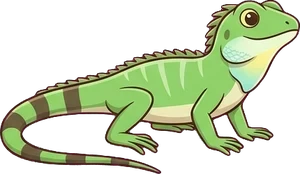
Chinese Water Dragon care guide
Physignathus cocincinus · Care info checked against current care sheets in November 2026
Quick facts
| Scientific name | Physignathus cocincinus |
|---|---|
| Also called | Asian water dragon, green water dragon |
| Care level | Intermediate |
| Active | Diurnal |
| Lives | Arboreal |
| Adult size | 60 to 90 cm (24 to 35 in) |
| Lifespan | 10 to 15 years |
| Minimum enclosure (one adult) | 180 x 90 x 180 cm (71 x 35 x 71 inches) |
| Basking spot | 32 to 35°C (90 to 95°F) |
| Warm side | 28 to 32°C (82 to 90°F) |
| Cool side | 24 to 30°C (75 to 86°F) |
| Night | 21 to 25°C (70 to 77°F) |
| Humidity | 60 to 85% |
| UVB lighting | Required (Ferguson zone 3) |
| Diet | Omnivore |
| Feeding, babies | every day |
| Feeding, juveniles | every 2 days |
| Feeding, adults | every 3 to 5 days |
Overview
A big, bright green lizard from the forests and riverbanks of Southeast Asia. Water dragons are active climbers and swimmers that need a tall, very large enclosure with a pool, which makes them a bigger commitment than they look in the pet store.
Enclosure
An adult needs at least 180 x 90 x 180 cm (71 x 35 x 71 inches), and bigger is strongly recommended. Give plenty of sturdy branches, live plants, a deep pool of at least 250 liters, and solid sides that help stop nose rubbing on the glass.
Heat, humidity and lighting
Give a basking spot of 32 to 35°C (90 to 95°F), warm air of 28 to 32°C (82 to 90°F), a cool side of 24 to 30°C (75 to 86°F) and nights of 21 to 25°C (70 to 77°F). Keep humidity around 60 to 85% with good airflow. Use a strong UVB (a 10 to 12% T5 over about half the enclosure).
Diet
Hatchlings eat insects daily; juveniles get insects and salad every other day; adults get insects every 3 to 5 days and salad daily. Pinkies, feeder fish and fruit are treats once a week at most. Dust insects with calcium and a multivitamin and gut-load them first.
Health
Stress makes water dragons rub their noses raw on the glass, so cover the sides and give them room. Also watch for swollen limbs or a soft jaw (weak UVB or calcium), sunken eyes and mouth rot.
Handling
Leave a new dragon alone for two weeks, then build trust with tongs and food. Lift from below, never from above, and support the long tail. Many become tame, but they're nervous at first.
See a vet if you notice
Snout rubbing or a sore nose, swollen limbs or soft jaw, sunken eyes, mouth rot, weight loss.
Other languages: ČeštinaDeutschEspañolFrançaisBahasa IndonesiaItaliano日本語한국어NederlandsPolskiPortuguês (Brasil)SvenskaTürkçe简体中文